Why do Albania’s young protesters deserve protection, not punishment?
October 18, 2026
Europe’s protests, symptoms of a deeper crisis
October 24, 2026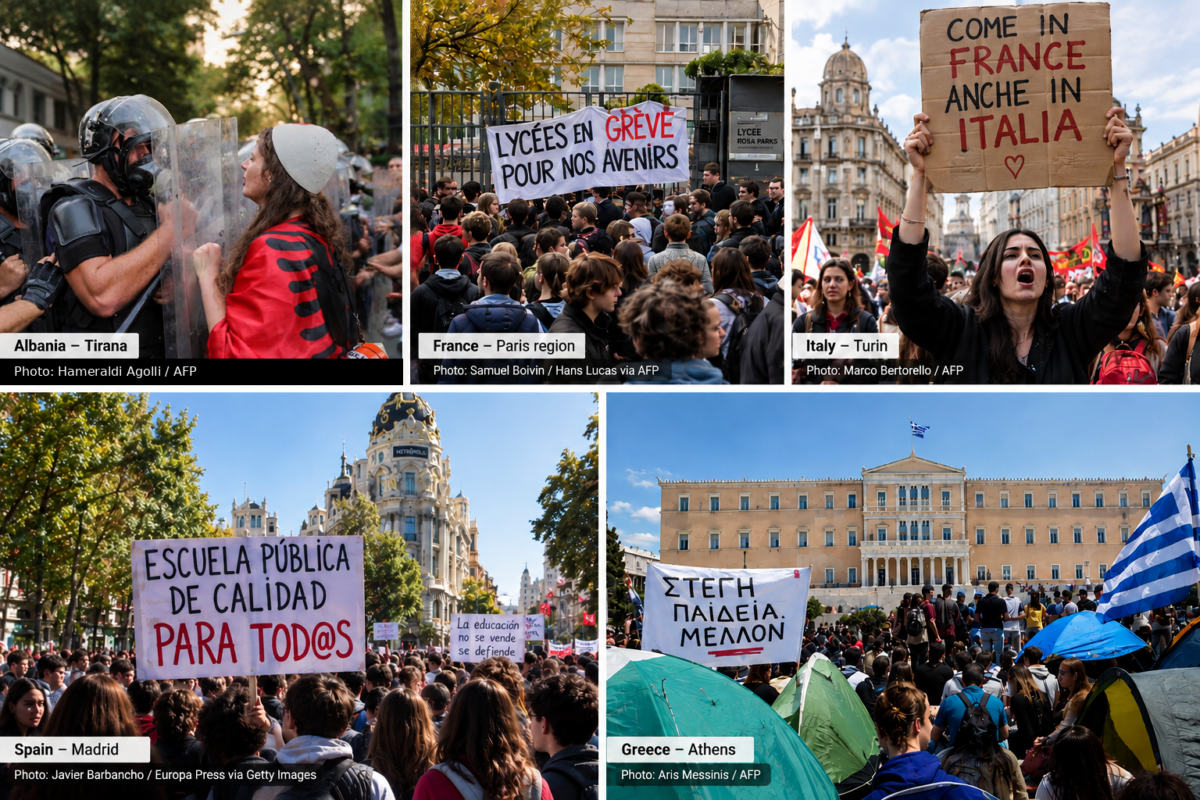
One autumn, many squares
The young people filling Tirana’s boulevards are not an isolated phenomenon. In mid-September, high-school students in the Paris region began blockading school entrances over missing teachers, overcrowded classrooms and crumbling buildings. Within weeks the protests had reached hundreds of schools, drawn in university students and unions, and brought crowds onto the streets that the Interior Ministry put at over 160,000 on 13 October, and unions at nearly 480,000. Belgian students followed in early October against tuition reforms and funding cuts. In Italy, high-school occupations began in Turin and Rome under the slogan “Let’s do as in France”, and a national school strike followed on 16 October. In Athens, students pitched tents opposite Parliament over rents and student housing. In Madrid, teachers, families and students joined an indefinite strike in defence of public schools.
Albania belongs on this map. Here the student movement grew out of the Flamingo Revolution, which began as a local protest over land and the environment, and has widened into governance demands.
Mobilisation without borders
These movements are not a single coordinated campaign, and it would be inaccurate to present them as one. Their triggers differ: mould and classroom heat in France, tuition fees in Belgium, rents in Greece, privatisation fears in Madrid, corruption and a stolen sense of future in Albania. Yet the underlying message is strikingly similar. Young people are saying that public institutions are not delivering the education, housing and opportunity they were promised, and that they are excluded from decisions that shape their lives.
The demands pass through borders. Students in France ask for emergency school renovation, large-scale teacher recruitment and real student representation. Students in Greece ask for rent controls and more student housing. Students in Tirana ask for transparency, accountability and an education that leads to a job at home rather than a ticket abroad.
What also unites this moment is the way it organises. Occupations, blockades, protest camps and daily marches are spreading through social media and student unions faster than any party or institution can respond. Slogans cross frontiers within days. In Italy, the movement openly borrowed from France. Albanian students, for their part, are as connected to this wave as their peers in Turin or Liège, and for Albania, a candidate country for EU membership, that matters. A generation that studies, works and votes as Europeans is asking to be treated by its institutions to European standards.
The same test for every government
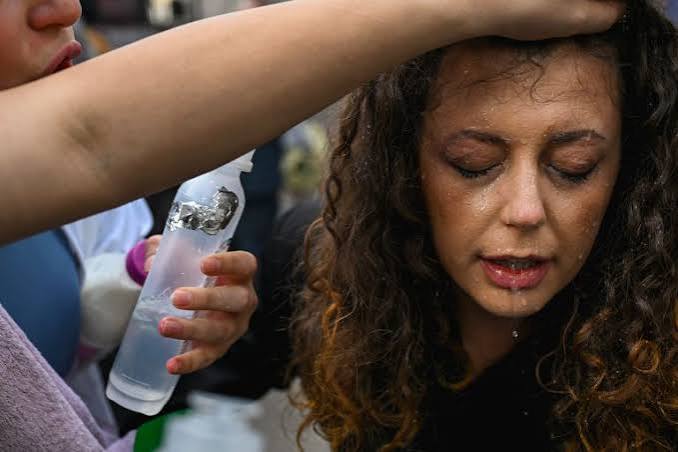
In nearly every country, the story of the protests has become a story about policing. In France, reports cite roughly 6,800 to 8,000 people taken into custody, around 85% of them minors, and a teenager who lost a hand, after which authorities suspended the use of stun grenades. In Belgium, police made well over a hundred arrests in Liège alone, and water cannon and tear gas were used in Brussels. In Tirana, tear gas, water cannon and batons were used against crowds, with more than 100 arrests reported at peak moments.
On the other side, property has been damaged, and officers and demonstrators have been injured, in Tirana as in Paris and Brussels. Violence against police is unlawful and cannot be justified, and every state has a legitimate duty to protect public order. But the standard is the same everywhere, and it does not depend on a country’s size or EU status. Article 11 of the European Convention on Human Rights, which binds France, Belgium, Italy, Greece, Spain and Albania alike, and Article 21 of the International Covenant on Civil and Political Rights guarantee the right to peaceful assembly. The case law of the European Court of Human Rights and the UN Human Rights Committee’s General Comment No. 37 is consistent: isolated violence by some does not strip an assembly of its peaceful character, and force must be lawful, necessary and proportionate. The OSCE/ODIHR and Venice Commission guidelines add that policing should facilitate assemblies and target violent individuals rather than the crowd as a whole.
Where children are concerned, the bar is higher still. Under the UN Convention on the Rights of the Child, detention of minors must be a measure of last resort, and their right to express views and assemble peacefully is protected in its own right. A protest movement in which the majority of those detained are minors should prompt a question in every capital, including Tirana, about whether the response is proportionate.
A credible response needs three things everywhere. First, policing of assemblies guided by necessity and proportionality, with less-lethal means as a last resort. Second, prompt, impartial and public investigation of every complaint of excessive force or ill-treatment, with particular care for minors in custody. Third, a real seat at the table: structured, accountable dialogue with student representatives, not only a security response.
>> About EEO Center
EEO – Center for Equity, Environment and Open Innovation is a Tirana-based organisation working on human rights, environment and open innovation. Our vision: EmPower, Engage, Omnia.