A generation across Europe on the streets
October 19, 2026
From attendance to inclusion: small changes that create space for every voice
October 29, 2026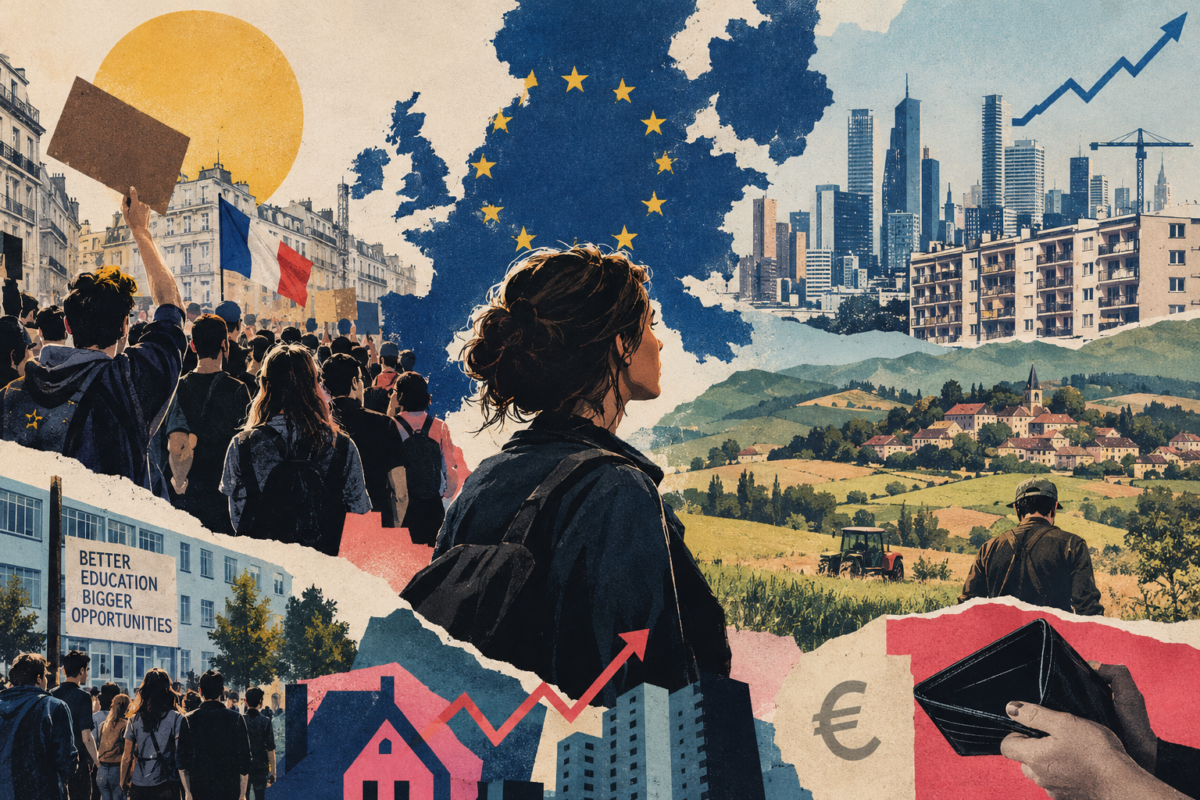
Why is economic progress no longer enough to give people confidence in the future?
Across Europe, people are going to the streets for different reasons. In France, students have protested against deteriorating school conditions, while workers have joined demonstrations over living costs. In Belgium, students have challenged education costs and budget cuts. In Italy, students have occupied schools, while farmers and truck drivers have protested against rising fuel costs. In Spain and Portugal, housing has become a major source of anger. In Greece, thousands of students and teachers have demonstrated for better public education, higher salaries and more affordable student housing. In Albania, young people have demonstrated against corruption and government policies.
These movements are not the same. Their demands, political contexts and participants differ. Yet they raise a common question: are Europe's protests separate problems, or signs of something deeper happening within our economic and social system?
Protest is a legitimate part of democracy. Violence, vandalism and looting are not. Understanding the causes of public frustration does not mean excusing destructive behaviour. But focusing only on the disorder, or treating each protest as an isolated event, risks missing the bigger picture.
An economy that creates wealth, but not always shared opportunities
Over the past thirty years, globalisation, new technologies and economies of scale have changed how we produce and consume. Companies can manufacture goods across several continents. Consumers can buy products that were once expensive or unavailable. International trade and technology have created enormous wealth and new opportunities.
But who benefits from this progress? The answer is not the same for everyone.
Some companies, investors and regions have gained significantly from global markets. Others have struggled with competition, factory closures, declining local industries or unstable employment.
Europe's middle class, long a foundation of economic stability, consumption, savings and entrepreneurship, is under pressure. According to the OECD, the share of people in middle-income households fell from 64% to 61% between the mid-1980s and mid-2010s, while their share of total income declined from 69% to 64%. More recently, Eurofound found that the middle class shrank in almost two-thirds of EU member states between 2006 and 2021. The trend differs across countries, but it raises a fundamental question: what happens to an economy when the social groups that have traditionally sustained its businesses, communities and aspirations gradually lose economic influence?
At the same time, economies have become more dependent on distant suppliers, international transport and energy markets. Wars, geopolitical tensions, climate-related disasters and rising energy costs have exposed the weaknesses of systems built mainly around efficiency and low production costs.
This constant search for efficiency and cost reduction has not been limited to private companies. Public policies have also increasingly focused on rationalisation, spending restraint and the consolidation of services, often putting pressure on healthcare, schools, universities and other public services. Yet when security priorities changed, governments rapidly mobilised enormous resources for defence, raising questions about public priorities and whether such major choices receive sufficient democratic debate. Reducing public expenditure may improve an institution's accounts, but it can also transfer costs to citizens, who increasingly have to pay privately for services that public systems struggle to provide.
The problem is not globalisation itself. It is that economic progress does not automatically translate into better living conditions, greater security or more opportunities for everyone. When the benefits are unevenly distributed, frustration grows.
The paradox of Europe's cities and smaller towns
Consider what is happening across many European territories. Young people leave smaller towns to study, find work and build their careers in large cities. This is understandable: universities, companies, specialised jobs and investment are often concentrated there. But moving to a city does not necessarily mean achieving a better life.
Housing costs can absorb much of a young worker's salary. According to Eurostat, house prices across the European Union increased by 53% between 2010 and 2024. In many cities, finding a stable job is no longer enough to guarantee an affordable home.
Meanwhile, smaller towns and rural areas face a different problem. Many offer space, nature, community life and potentially attractive living conditions. Yet some are losing factories, services, young people and economic opportunities.
This creates a cycle. Young people leave because opportunities are limited. Their departure reduces the number of workers, customers and potential entrepreneurs. Local businesses and services then find it harder to survive, making the territory even less attractive to the next generation.
People leave places where life could be good because opportunities are missing, only to reach places where opportunities exist but living becomes increasingly expensive. This is one of Europe's great territorial contradictions. It also helps explain why very different groups may feel insecure: young urban workers struggle to afford housing, while farmers, small businesses and communities in less dynamic regions worry about losing their livelihoods. They are not necessarily protesting for the same reasons, but their difficulties can be connected.
From a society of production to a society of consumption
There is another contradiction, particularly important for younger generations. Over recent decades, consumption has become one of the main ways people express success, identity and social status. Social media has made this even more visible. Every day, young people see images of expensive holidays, fashionable clothes, beautiful homes and apparently effortless wealth. What they rarely see is the work, inherited advantages, financial risks, or carefully constructed appearances behind these lifestyles.
The result is a growing distance between what people are encouraged to desire and what they can realistically afford. Our aspirations have become global, but our opportunities remain unequal.
Consumption is not only about satisfying basic needs. It can also be about recognition and belonging. Being unable to participate in the lifestyles celebrated around us may therefore create not only economic frustration, but also a feeling of social exclusion.
This does not explain or justify looting during protests. Such acts have different motivations, and most people facing economic hardship never engage in them. But the attraction of branded goods and symbols of wealth raises a broader question about the society we have created.
Are we encouraging young people to become successful citizens, skilled professionals and active members of their communities, or mainly successful consumers? And what happens when society constantly encourages consumption but fails to provide enough opportunities to earn a decent living?
Technology will make these questions even more urgent
Artificial intelligence could bring major improvements in productivity, healthcare, education and business. But increased productivity does not automatically mean higher wages, shorter working hours or greater economic security.
Who will benefit from the wealth created by AI? Will it help small businesses, workers and local communities become more productive? Or will most of the gains flow towards the companies and investors that control the technology?
Both outcomes are possible. Much will depend on education, access to technology, competition and how the benefits are shared. Without careful choices, technological progress could reinforce inequalities that already exist.
A system of connected problems
These challenges are often discussed separately: housing, wages, education, agriculture, migration, climate change or technological disruption. But they are connected.
When economic opportunities become concentrated in a few places, people move towards them. This can increase housing pressure in cities while weakening smaller communities. When work becomes insecure and housing expensive, young people may struggle to save, invest in their education or start families.
When communities lose jobs, services and confidence in their future, trust in political institutions can decline. And when trust declines, it becomes harder to agree on the long-term changes needed to solve these problems.
Each difficulty can make the others worse. This does not mean that every protest has the same cause. Some are primarily about democratic rights, corruption, or specific political decisions. But many of the pressures behind them are part of a wider system that is struggling to offer security and opportunity to all.
The real crisis is about the future
Perhaps the deepest problem is not simply inequality in income or wealth. It is inequality in the ability to build a future. For decades, many Europeans believed that education, hard work and economic growth would lead to a better life. Today, that expectation is less certain.
You can study until you have a master's and still struggle to find suitable and long-lasting work. You can work full-time and still be unable to afford a home. You can live in a beautiful region and find few opportunities to build a career. And you can watch the economy become more productive without feeling that your own life is improving.
Europe does not need to reject globalisation, technology or economic growth. It needs to rethink how their benefits are shared and how opportunities are created. That means investing in education, affordable housing, productive businesses and resilient communities. It also means allowing different territories to develop different economic models, based on their own resources, skills and identities, rather than expecting every place to follow the same path.
The goal should not simply be to produce more and consume more. It should be to give people greater freedom to choose where and how they want to live, work and contribute.
Europe's protests may be warning signs of a society losing confidence that progress will lead to a better tomorrow.
The question is no longer only whether Europe can continue to create wealth. It is whether it can turn that wealth into opportunities, dignity and a future that more people can believe in.
>> About the Author
Stéphane Jedrzejczak, PhD, is a researcher, consultant and international trainer with over a decade of experience in sustainability, innovation and territorial development. Combining systems thinking and strategic foresight, he works with organisations and communities to explore new possibilities and create economic, social and cultural value. His experience spans universities, applied research centres, international organisations and local communities across Europe, Asia and Africa.