From projects to possibilities: Development about building futures, not just delivering activities
November 7, 2026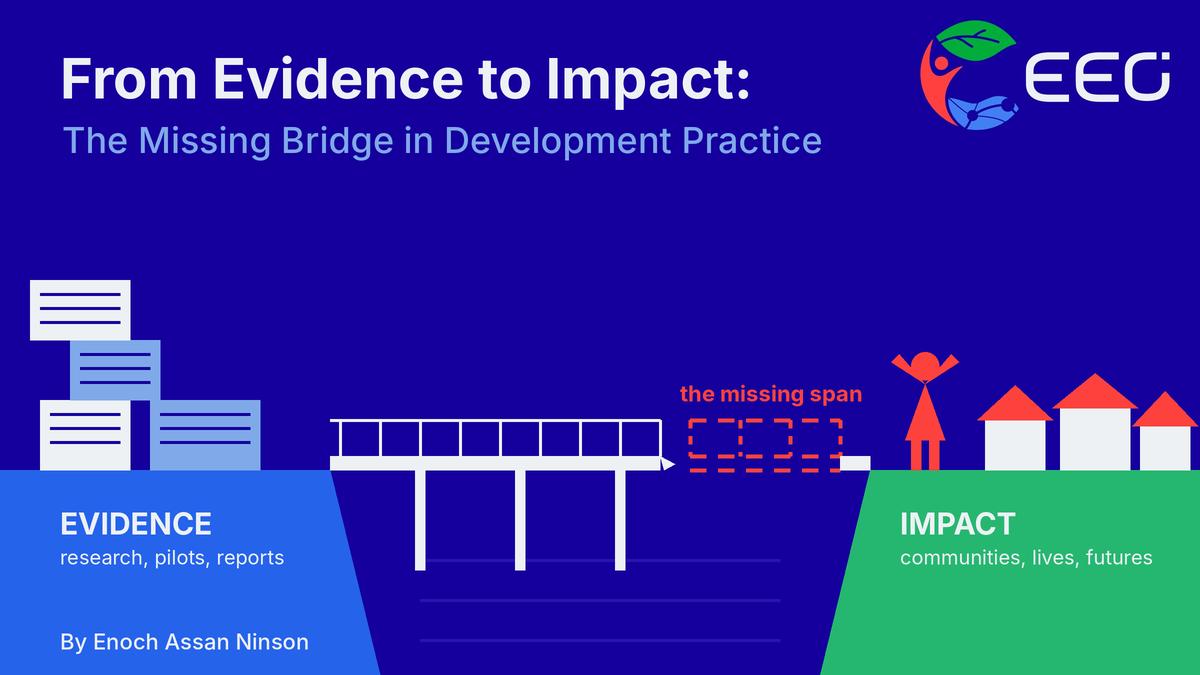
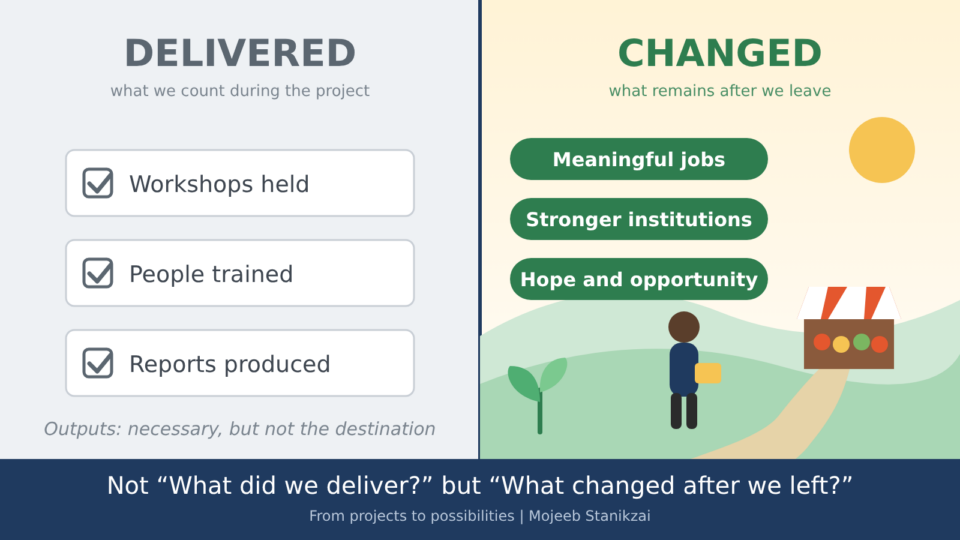
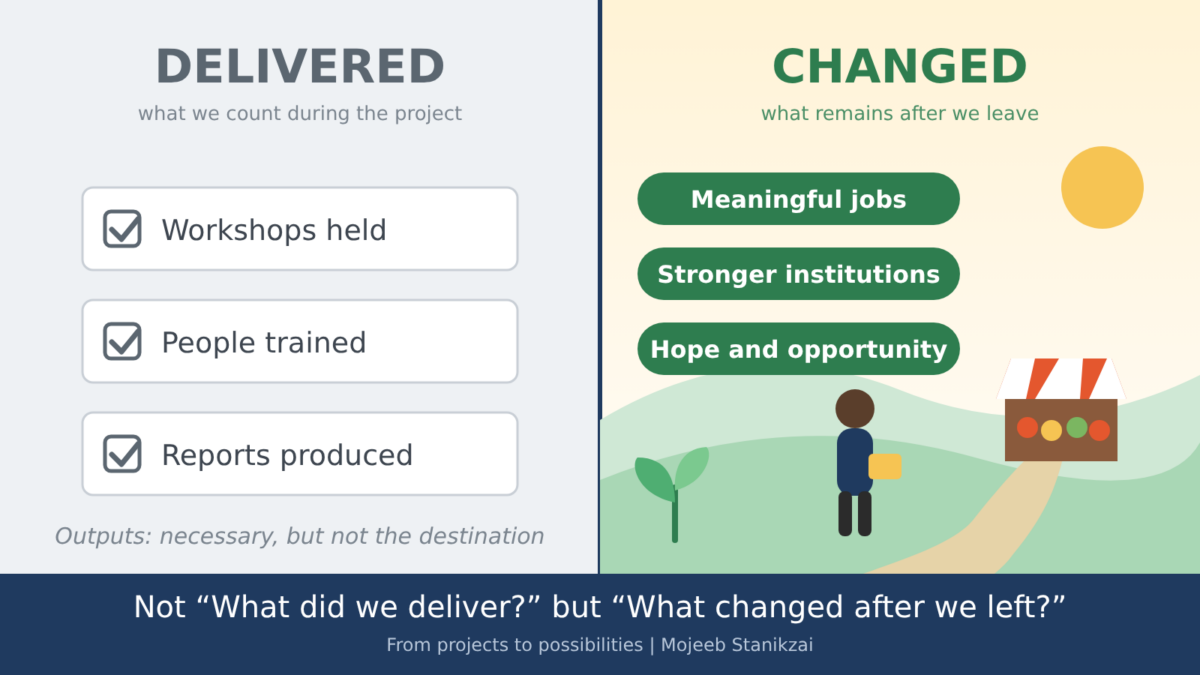
My colleague Mojeeb Stanikzai wrote an interesting article. "Development is about building futures, not just delivering activities." It is difficult to disagree with this central message. He argues that success should not be measured by the number of workshops conducted, reports produced, or projects completed but by how people's lives improve in lasting ways. This resonates very well.
His argument raises a challenge hiding in plain sight. Even when research identifies solutions that can improve lives and build futures, too many never make the journey from evidence to action. They remain stuck in what I would like to describe as the gap between evidence generation and evidence utilization.
This gap reminds me of a story I heard at a workshop a few years ago. A team of researchers spent months working with farming communities vulnerable to climate shocks. They collected data, tested interventions, held community consultations, and finally produced clear evidence of a community-based extension model that works. Farmers who participated in this model adopted more resilient practices, recovered faster after weather shocks, and reported improved livelihoods. This strong evidence was supported by local leaders and communities. As usual, the findings and recommendations were presented at conferences and published in reputable journals.
And then the research ended and everything stalled in the communities. Not because the intervention failed or the communities rejected it or policy makers disagreed. It failed because there was no prior intention to implement the intervention at scale.
This story is not unusual. Across development sectors, many promising ideas often reach the finish line of research but never reach the starting line of implementation. Evidence-based decision-making has become a defining strength of development practice, yet we rarely discuss what happens when good evidence gets missing in action. This gap between evidence generation and evidence utilization may be one of the most overlooked challenges in development today.
The Graveyard of Successful Pilots
Anyone who has worked in development has likely encountered what might be called the "pilot project graveyard." Permit me to share another story. This time a personal one. The last project I managed was a pilot that followed rigorous scientific premise. We implemented the first online HIV testing intervention in Ghana. Users, mostly young people, ordered for HIV test kits online. The kits were delivered to them in their comfort zones. An online team of health professionals engaged these young users to perform the test, read and interpret the results and choose either the treatment or prevention pathway based on the results of the test.
This pilot project was successful. The greatest barrier to HIV testing, stigma and discrimination, was eliminated outright. Many young people, particularly young men, who were an important missing population in HIV testing interventions, were reached. Both local and international stakeholders loved the project. Overall, the intervention could be described as promising, innovative, and impactful.
Then it disappeared after the end of the pilot. There was no funding to continue and scale up. Three years after the project, young people who knew I was the manager still call me to enquire about the project. My staff report similar experiences. This project did not fail scientifically. It failed financially. Somewhere between evidence generation and scale-up, the pathway to implementation funding broke down.
This is the uncomfortable reality beneath many discussions about development building futures. Being proven effective is not the same thing as being funded for adoption.
Two Conversations Happening in Different Rooms
Development funding often operates like two important conversations happening in separate rooms. In one room, researchers are working to understand problems, test solutions, and generate knowledge. In this room, Universities conduct studies, research institutions run pilots, and evaluators assess what works and what does not. In this same room, research funders are rewarding scientific rigor, innovation, and new knowledge.
In the other room, governments, NGOs, and development agencies are focused on service delivery, scale, operational challenges, and measurable results. Their funders are asking questions about reach, efficiency, alignment with priorities and impact.
The problem here is that these two rooms are not always talking to each other even though they are both trying to improve people's lives. As a result, researchers sometimes generate excellent evidence that does not match implementation priorities, while implementers sometimes pursue intervention priorities that have limited evidence behind them. The problem is not a failure of research or implementation, rather a failure of alignment.
Implementation Science Helped, But It Did Not Solve Everything
To be fair, the development community has not ignored this challenge. For decades, researchers recognized that too much evidence remained trapped in journals, reports, and pilot studies. Policymakers struggled to use research findings, and practitioners often found that successful research interventions never reached communities at scale.
Implementation science emerged as a response with a simple central question: How do we ensure that effective interventions are actually adopted, scaled, and sustained in real-world settings?
Over the years, implementation science has generated valuable insights into stakeholder engagement, scale-up, organizational readiness, sustainability, and knowledge translation. Beyond these, research funders increasingly ask applicants to include dissemination plans, theories of change, and pathways to impact.
These are important advances but have not solved the problem entirely. This is because implementation readiness does not automatically create implementation financing. In other words, we may have become very good at asking, “Can this intervention work in practice?" But we are still not asking often enough, “Who will pay for it if it does?"
What If We Asked a Different Question?
Imagine two research proposals landing on a donor's desk. The first identifies an important knowledge gap and proposes a rigorous scientific study. The second does the same thing but goes further. It includes letters of support from government agencies. It identifies implementation partners. It demonstrates demand from organizations facing the problem. It outlines potential pathways for financing scale-up if the findings prove successful.
Scientifically, both proposals may be excellent. But which is more likely to improve lives five years from now? The answer seems obvious. Yet most research funding mechanisms still place overwhelming emphasis on generating evidence and relatively little emphasis on ensuring that evidence can realistically travel the final mile to impact.
What if research funders required applicants to demonstrate not only scientific relevance but also implementation demand and potential financing pathways from the outset? Not because every study must guarantee scale-up. But because impact becomes more likely when those who might fund and use the findings are involved from the beginning.
Why This Matters Even More Today
This conversation is particularly urgent now. Around the world, development resources are becoming more constrained, aid budgets are tightening, governments face fiscal pressures and donors are increasingly expected to demonstrate value for money and measurable impact.
In an era of abundant funding, promising interventions could sometimes survive on the hope that another donor, another grant opportunity, or another champion would eventually take them forward. That era is becoming less certain.
When resources are scarce, misalignment becomes expensive. Every research investment that fails to influence implementation represents a missed opportunity. Every implementation investment that ignores the best available evidence increases the risk of spending resources on approaches that are less effective.
Simply put, the development sector can no longer afford for evidence and financing to exist in separate worlds.
Building Bridges, Not Just Evidence
Much of the development community's attention has rightly focused on improving evidence generation and strengthening implementation. Significant progress has been made on both fronts. Yet somewhere between generating knowledge and changing lives, too many promising ideas disappear.
Communities do not benefit when evidence sits in a journal, a report, or a conference presentation. We know about many solutions because researchers have spent years producing the evidence. But evidence alone does not vaccinate a child. It does not keep a girl in school. It does not help a farmer survive a drought. Communities benefit when that evidence becomes a program, when that program is funded, and when that funding allows impact to be sustained over time.
The tragedy is not that we lack ideas. The tragedy is that too often we already know what works, yet communities never experience the benefits because the bridge between evidence and action was never built.
If development is truly about building futures rather than delivering activities, then perhaps the next frontier is not simply producing better research or designing better programs. Perhaps it is building stronger bridges. Bridges between researchers and implementers. Bridges between evidence and financing. Bridges between those who generate knowledge and those who fund change.
Because every report that sits on a shelf represents more than unused evidence. It represents lives not improved, opportunities not realized, and futures that could have been different. Communities do not measure success by the evidence we generate, the papers we publish, or the conferences where findings are presented.
And ultimately, the value of research is not measured by what we learn. It is measured by what changes because we learned it.
Until then, evidence remains a promise. Impact is the fulfilment of that promise.
>> About the Author
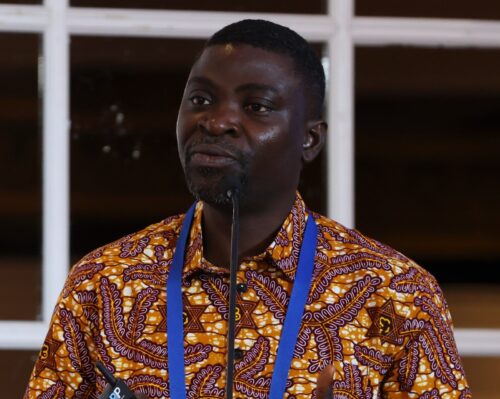
Enoch Assan Ninson is an Erasmus, Commonwealth and HKPFS scholar. He transitioned into academia after 15 years’ experience designing, implementing and managing HIV and AIDS projects for Gender and Sexual Minorities (female sex workers, Men who have sex with Men), Security services (Military), young people (15 - 24years) and General population. He is currently a PhD candidate.